


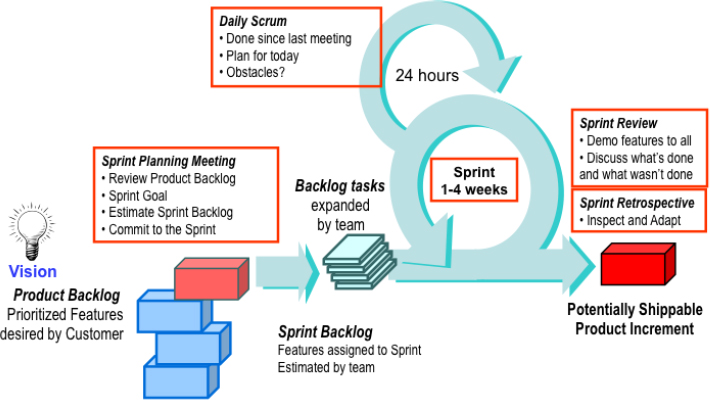
 Scrum is a methodology designed within the scope of Project Management that helps us break down a job into many time intervals. The next step is to divide the work we have to do into components so small that they can fit into the chosen time interval, which is usually one week.
As in Kanban, we will use sticky notes to represent each individual activity and a board that shows the phases of the workflow. The substantial difference between Kanban and Scrum is that in the second methodology we have much more planning.
For this reason, it is a tool that is better applied in the management of a complex project such as the design, implementation and certification of a management system according to ISO 9001, ISO 14001 or ISO 27001. Ideal for Scrum is also an environment where little supervision is needed. For each time interval, a goal is set to be achieved and work is assigned in that area in order to achieve the specific goal. At the end of the interval set for the end of the work, a review is made and, if the work is approved, it is released.
The results of what has been done in each work session are reviewed during specific meetings and serve as feedback to improve the process.
To use the Scrum methodology, some key figures are needed:
- The "product owner" (manages priorities, talks to stakeholders, takes care of the product or service);
- The scrum master (supervises the process, removes obstacles and acts as a facilitator);
- The other members of the team who are the material executors of the work.
Scrum works well on projects that need to be worked on quickly but for which a minimum of planning and coordination of work is needed. The advantages of Scrum are:
- A great possibility of knowing in advance how the work will be managed - Scrum relies on good planning and each part of the work must be aligned with the established objectives. In addition, the methodology requires that the established work be completed within the estimated timeframe, so the timing is also very clear;
- Rapid improvements - Scrum allows rapid interactions and equally rapid improvements, given its structure divided into intervals. A part of the work is completed, reviewed, released and, if changes are needed, they are made immediately, in the next work interval;
- Greater collaboration - teams coordinate to carry out the work along the process and, therefore, communicate regularly and collaborate so that the work is completed within the expected time frame;
- Autonomous organization - teams that work with Scrum organize themselves independently, without the need for superiors to intervene, and this also accelerates any decisions.
The disadvantages of Scrum are:
- To be able to implement Scrum, a specific structure is needed - there are specific meetings and processes, so it is not a tool that can be applied anywhere. The fact, then, that people have well-defined roles requires that there has been the necessary training. Finally, each time interval is well defined, so it is impossible to add or remove work in these units;
- It is necessary to familiarize yourself with the basic concepts - it takes some time to learn how to work according to the principles of Scrum, which is not intuitive;
- Good planning ability is needed - if the work is not divided into adequate smaller intervals, it will not be possible to carry it out within the expected time frame and the entire project will be delayed.
This methodology is perfect to use if:
- A controlled delivery of the product or provision of the service is required;
- It is necessary to test the chosen solutions;
- The work can be completed by a small team.